A distributor wants two sample crates. The manufacturer sends its best pair, pays the carriage and hears three weeks later that everyone liked them. The buyer still has no basis for placing a stocking order. Nobody compared the crates with the current model, the warehouse supervisor missed the demonstration and the salesperson who requested the samples cannot approve a purchase. Before booking a courier, agree on a decision that the people receiving the product are equipped to make.
Start with the decision at the other end
Ask the prospective partner to finish one sentence. “If this trial succeeds, we can decide whether to buy a starter quantity for our northern depot.” That tells the supplier which site, which use and which commercial commitment the trial should support. “We want to see the quality” leaves almost everything unresolved. An exploratory sample can still serve a purpose, such as selecting a finish for a catalogue. Call it an exploratory sample and budget accordingly.
Choose a decision owner and an operator. A category buyer may control the assortment while a packing supervisor controls access to the shift where a crate can be tried. A technical specialist can advise on suitability. A finance colleague can confirm the margin. Each has a different reason to participate. Record their roles and preferred contact route in the trial note. A name on a courier receipt proves that someone accepted a parcel. It provides little evidence that a warehouse team accepted responsibility for an evaluation.
Walk through one ordinary job
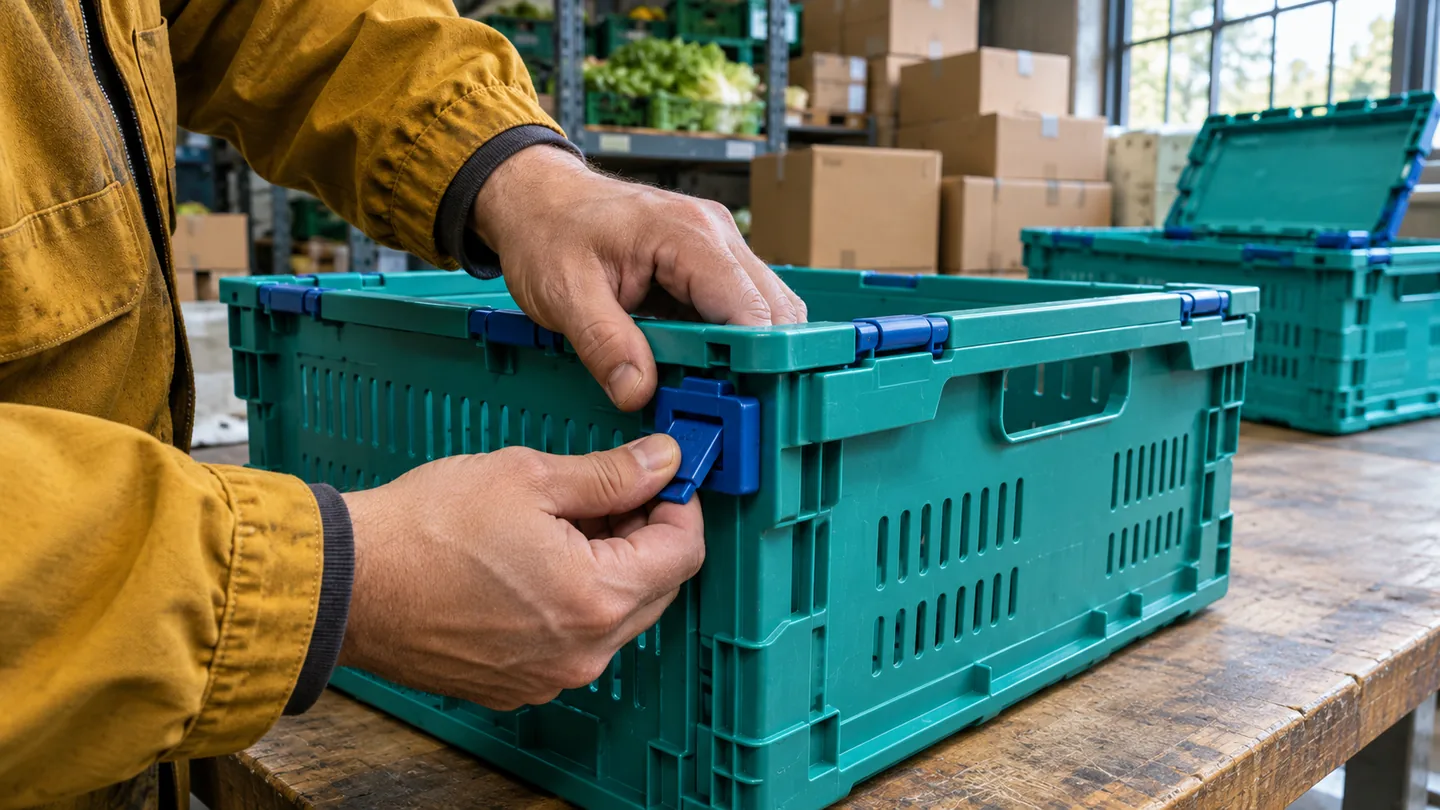
Imagine a supplier of reusable folding crates and a regional produce distributor. The buyer is considering a first order for a depot that delivers to independent grocers. Observe how an existing crate travels through picking, stacking, loading, unloading, empty return, washing and storage. Identify the step that makes the current design expensive. In this fictional depot, staff repeatedly pause to close a stiff latch while wearing gloves. Empty crates also occupy a crowded corner near the loading door.
Turn those complaints into observable questions. Can a picker close both ends correctly on the first attempt? Does the empty crate fold to fit the measured space on the return cart? Does a label remain legible after the normal wash cycle? Write down the current crate dimensions, label material, gloves in use and usual wash settings. The supplier’s smooth demonstration in a quiet meeting room would answer few of these questions. The trial belongs where the problem occurs.
Choose a representative task that can be completed within a sensible window. Testing an entire distribution network may obscure a basic fit issue. Testing a single clean crate on a buyer’s desk may miss every meaningful difficulty. A practical starting point is one depot, one route and two shifts with different supervisors. Treat the numbers here as examples. A buyer distributing decorative glassware would choose different loads, handling surfaces and damage checks from a customer moving leafy vegetables.
Agree on pass conditions before the delivery
Separate essential requirements from preferences. A crate that cannot sit securely on the depot’s existing dolly fails a compatibility check even if everyone likes its colour. Define the test with the equipment owner and stay within the manufacturer’s rated use. An unfamiliar material may also need a specialist review for the intended application. Obtain that clearance before operational handling. A sales trial has limited scope and cannot establish regulatory compliance, long-term durability or suitability for every environment.
For a preference, agree what a better result would look like. The buyer might want at least nine successful first closures in ten comparable attempts. Staff could record second attempts and explain what prevented closure. Another criterion could be minutes spent preparing an empty return cart. A distributor with reliable baseline figures can set a meaningful target. Where experience is thin, let the first exercise establish a baseline and schedule a separate confirmation before making a purchasing commitment.
If several designs clear the mandatory checks, a weighted comparison can help the buyer discuss trade-offs. Agree in advance which matters most among handling, cleaning, storage and cost. Give each score a plain description and preserve the raw observations beneath it. Ask two evaluators to explain a disagreement instead of averaging their ratings immediately. The American Society for Quality explains how to compare alternatives against weighted criteria in its decision matrix guide.
Send a kit someone can identify and return
Record a short identifier for each sample, the design revision, accessories, condition, destination and expected return date. Photograph the latch, hinge and base before dispatch. If one crate has a prototype hinge and another has the production fitting, mark them separately. A distributor cannot reproduce a successful trial if the subsequent order refers to an obsolete revision. A short packing inventory also avoids blaming the evaluator for an insert left on the supplier’s assembly bench.
Agree who pays freight and who arranges collection. Specify whether the sample is a loan, a gift or a paid evaluation unit. Record who authorises destructive testing if the buyer requests it and which checks can be completed without damage. Include ordinary operating instructions and a real support contact. Tell the receiving desk what to do with an unexpected parcel and where to leave it if the intended supervisor is away. A photograph of the actual carton can save a surprising amount of searching.
Check the route before promising a delivery day. A carrier may deliver to the distributor’s office while the evaluation is scheduled at a different depot. A sample travelling across a border can require paperwork appropriate to its goods, destination and intended treatment. Ask the shipping specialist to confirm the arrangement for this shipment. Logistics assumptions belong in the trial budget, especially if the expected first order is small or the return trip costs more than the sample itself.
Compare like with like during the shift
The supervisor assigns one current crate and one candidate to the same picking task. Each operator tries the familiar and unfamiliar design after a short explanation. Alternate the order when practical. Use similar loads and record unusual interruptions. A trolley wheel that jams halfway through a timed walk explains a delay better than a change of crate design does. Preserve the interrupted observation with a note and make a comparable repeat if the buyer agrees.
A tally can be more reliable than a polished questionnaire. Create one row per attempt with fields for sample ID, shift, task, first closure, repeat closure and comments. Introduce a distinct mark for “unobserved.” A blank square could otherwise mean success, failure, absence or simple forgetfulness. Test the form with one operator, adjust confusing wording, then keep the definitions steady for the comparison. ASQ gives a practical introduction to structured observation in its check sheet guidance.
Let people describe awkward features in their own words. One picker may say the catch is hard to reach while holding a tray. Another may notice that a printed arrow disappears behind a gloved thumb. Those descriptions point to different remedies. Record which hand, posture and load were involved if the operator is comfortable demonstrating. Take close photographs of the component when authorised. Keep identifiable customers, staff badges and shipment labels out of shared images unless there is a specific reason and permission to include them.
Calculate what a difference would be worth
Suppose the candidate saves eight seconds on each completed handling cycle. At an assumed 180 cycles a day, the saving is 1,440 seconds, or 24 minutes. Across 220 comparable working days that amounts to 88 hours. At an illustrative labour cost of CHF 32 per hour, the annual time value would be CHF 2,816. Label these figures as assumptions until the depot confirms volumes and payroll assumptions. A calculation the buyer can challenge is worth more than a confident payback claim.
Translate that arithmetic into the depot’s decision. If workers simply finish one low-volume task sooner and remain available for the same shift, payroll may stay unchanged. The value could lie in loading a second van before the collection deadline or recovering time for inspection. Ask the operations manager which outcome is attainable. Include added costs such as replacement parts, training, return freight, storage, deposits and any difference in cleaning time. A cheaper purchase can create a costly return journey.
Run one modest sensitivity check. Halve the expected daily use from 180 to 90 cycles and the example’s annual labour-time value falls to CHF 1,408. Compare it with the incremental price of the proposed batch and realistic service costs over the chosen period. Use the buyer’s preferred unit, whether that is cost per delivery, per completed trip or per crate in circulation. Dividing an annual saving for an entire depot by the purchase price of a single crate would make the business case meaningless.
Handle mixed feedback without losing the buyer
Imagine that day-shift staff report easy closure and the evening crew reports frequent jams. Look for a difference in conditions. The evening team might fill crates nearer the rim, wear thicker gloves or work at a lower bench. A scratched prototype could also behave differently after repeated washing. Ask the two supervisors to repeat a small number of observations under matched conditions. A product engineer can investigate the specific mechanism once the team has described it precisely.
Sometimes the buyer changes the brief halfway through. It may start with an empty-return problem and finish by asking whether the same crate works on a new automated line. Document the new question and identify the owner of that equipment. Agree separately on any further validation. The original trial can still answer the return-storage question. A distributor should be able to report one completed decision even while a second opportunity remains open.
A quiet distributor warrants a different response. Confirm receipt, locate the kit and offer two practical options, a short supervised test or a collection slot. If the buyer lacks a site or a sponsor, close the trial as unevaluated and recover reusable equipment. There is no basis for recording a product rejection. The experience may instead show that partner discovery was incomplete. Review the distributor finding process before allocating the next batch of demonstration stock.
Turn the review meeting into an order or a useful stop
Bring the physical sample, the baseline, the short observation sheet and a draft first-order specification. Identify every unmet essential requirement before discussing preferences. Let the buyer summarise what staff observed. Then ask what can be decided today. Possible outcomes include stocking the tested revision at one depot, requesting an agreed modification, commissioning a broader trial or declining the product for the stated application. Record the reason, responsible person and next date while participants still remember the details.
For a first order, confirm the actual model, colour, pack quantity, price basis, freight arrangement and any spare latches included. Clarify whether photographs and handling notes may be used to train the distributor’s sales staff. Agree how initial defects will be reported and where replacement components will come from. If commercial details remain open, label them individually and name the person who can settle each point. Use the pilot pricing guide to agree scope and fees.
Finally, close the loop at the supplier’s warehouse. Record which unit came back, what changed during use and whether it can safely go out again. Share one precise lesson with production and one with the commercial team. A recessed latch might deserve a design review. A missing depot sponsor might justify a new question before dispatch. The next distributor then receives a cleaner test, and the sales manager can distinguish an encouraging conversation from a buying decision supported by evidence.